Profitability is the foundation of any dental clinic, but it is often the first thing to be disregarded when the practice is overwhelmed with patients, paperwork, or a small staff. Dentists hardly have the time to assess the areas of money leakage, where the value is being created, and what must be restructured. That is where dental clinic software stops being a simple administrative tool and becomes a strategic contributor to financial performance.
Llack of profitability can mean a clinic appears active but still misses profit due to no-shows, poor follow-ups, inefficient workflows, and inconsistent treatment acceptance. Modern dental practice software helps remove these blind spots by simplifying operations, enhancing patient continuity, and making revenue trends crystal clear.
Why Does Profitability Matter so Much in Dental Practices?
Profitability is necessary because it determines whether a dental practice is merely surviving or expanding strategically. This is what most clinics underestimate: they consider busyness the measure of success, but a busy schedule is not a factor when income is not growing consistently. Inefficiencies in operations, inconsistent patient care, and unpredictable patient flow are quietly eating into margins. It also absorbs the practice in the sluggish months and amidst unpredictable disruptions.
To summarize, the dental clinic profitability is not a number; it is the foundation for clinical excellence, patient satisfaction, and long-term sustainability.
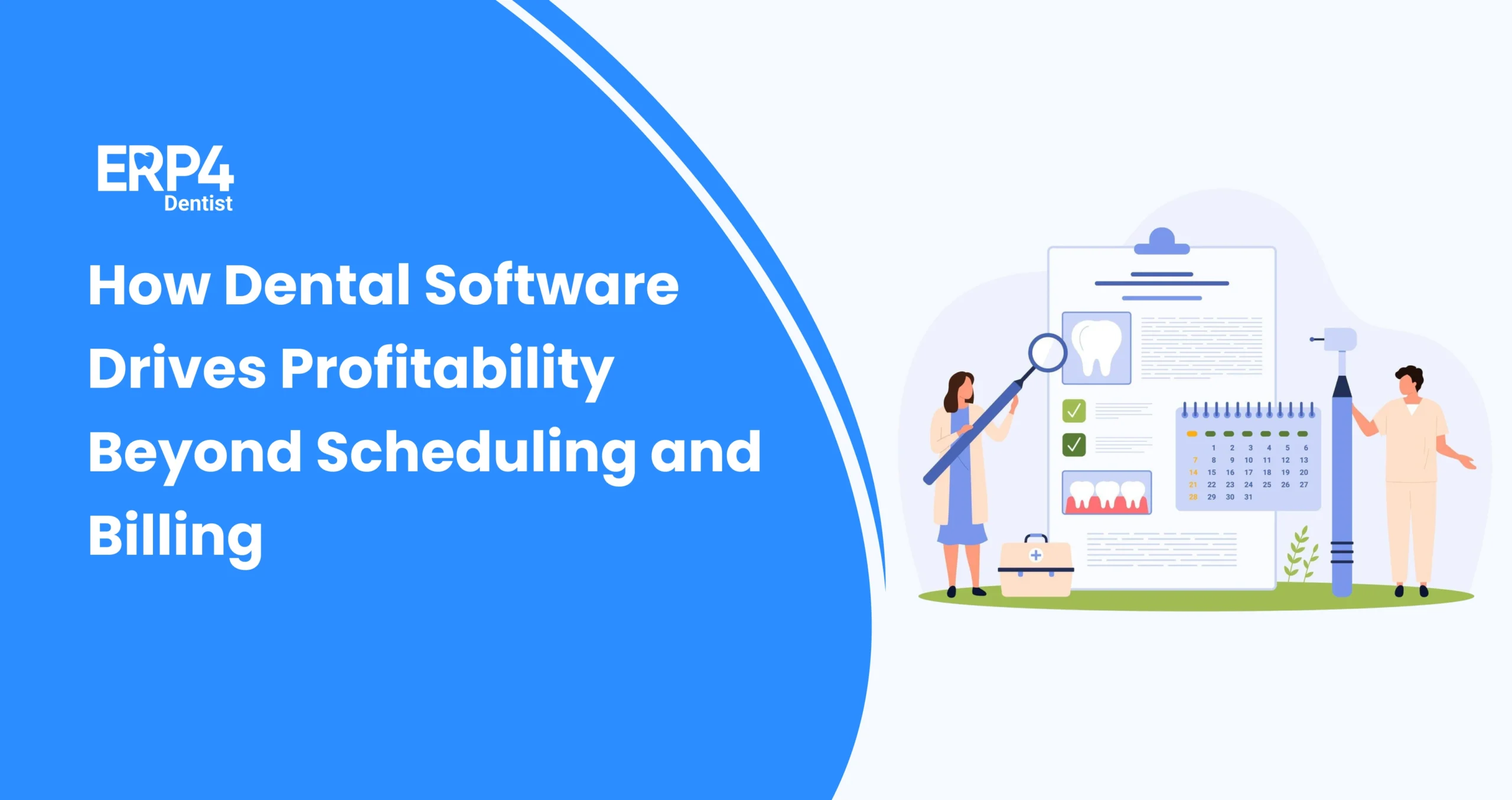
How Dental Software Boosts Profitability Beyond Scheduling and Billing
Most clinics believe that dental clinic software is only helpful for scheduling and billing, but this is a myth. The profit boosters are the more nuanced, invisible functions that justify work processes, enhance patient connections, and close revenue cycle holes. It is also here that modern dental practice software not only exceeds administration, but also becomes a growth engine.
-
Reduces No-shows and Cancellations
An empty appointment slot means that a clinic is losing money. The contemporary dental practice software addresses this issue by automating reminders, sending confirmations, and highlighting those patients who often miss appointments. This makes the schedule stricter, minimizes the last-minute delays, and even normalizes daily profits. Dental ERP reduces no shows and late cancellations.
-
Improves Patient Retention and Loyalty
The most potent source of revenue is the loyal patients. Software assists in monitoring the recall cycles, missed check-ups, and follow-up treatments to ensure that none fall through the cracks. Regular communication increases trust, and returning patients directly increases long-term dental practice profitability.
-
Enhances Treatment Plan
Clear, well-structured treatment plans enhance acceptance. The software enables doctors to present clear, transparent plans that include costs, benefits, and schedules, making it easier for patients to decide and enhancing treatment conversion rates.
-
Provides Actionable Analytics for Revenue Growth
Intuition lacks what is revealed in data. Clinics will be able to monitor revenue trends, poorly performing procedures, employee performance, and where profits are seeping with built-in analytics. This is how financial performance becomes not a guess but a system that can be predicted and optimised.
How to Calculate ROI for a Dental Software
Return on investment, or ROI calculation will help you determine whether the software is actually contributing to profitability or is another cost factor.
Formula for calculating ROI for Dental Software:
(Gain – Investment) / Investment
Take the profit you have made over the stipulated time frame, subtract it from the investment you have made, and finally divide the total by the invested amount. Monitor outcomes over 6-12 months to observe actual trends.
For example, when a clinic earns an additional ₹300,000 in a year by decreasing no-shows, increasing treatment acceptance, and streamlining workflows, and if the annual software price is ₹60,000, the ROI is (₹300,000 – ₹60,000)/₹60,000 = 4, which is a 400 percent return.
This transparency enables clinics to ensure upgrades, scaling, and long-term adoption.
It is absolutely essential to understand the essence of tracking your clinic’s ROI to know where you are and where your money is going. Actions without planning and analysis are chaos waiting to happen.
5 Challenges that can Affect ROI
The most effective software will not yield results unless the clinic’s major problems in functioning are addressed. ROI fails when teams resist change, processes remain stable, or billing mistakes accumulate silently. Early detection of such roadblocks will ensure that profitability is high and predictable.
-
Limited Staff Adoption
Without proper training, the dental practice software will not be used to its full potential, resulting in slow workflows and poor gains. Training and well-defined SOPs will ensure that all staff members adhere to a streamlined procedure.
-
Poor Data Entry Discipline
The system is unable to produce reliable insights when the staff key incomplete or inconsistent information. This undermines decisions on the profitability of dental clinics and conceals revenue leaks. The standardised data maintains the reliability of analytics.
-
Inefficient Billing Practices
Despite excellent dental billing software or a dental billing system, any coding, claim submission, or follow-up errors may suffocate revenue and impact the overall profitability of the dental practice. Strict billing policies minimize leakages and increase cash flow.
-
Inconsistent Workflow Implementation
Even high-end dental office software doesn’t work when everyone in the office follows different procedures. This creates redundancy, delays, and frustrated patients. Workflow standardization ensures the system does not cause chaos but rather enhances efficiency.
-
Lack of Ongoing Optimisation
The failure to conduct periodic reviews means the clinic will not be able to make fine adjustments to its setup or adapt it to new needs, resulting in a long-term decrease in the dental practice’s earnings. The unceasing optimism maintains performance acuity and increases ROI.
Final Word
Increasing profitability in a dental clinic is not something that just happens, but it is a planned process. The practices mostly put much emphasis on patient flow but fail to consider the areas of operation where money is silently being wasted. Modern dental clinic software provides the structure, visibility, and consistency required by clinics to enhance all revenue streams without increasing workload.
To be truly beneficial, clinics need to track ROI within 3-6 months, streamline workflows, and ensure the team uses the system as planned. The ROI doubles every month when it is disciplined. ERP4 Dentist, the Patient Communication Software Dental helps you in achieving it through our modern patient management software.
When you are ready to take profitability to a new level with clarity and control, You need to check out our free trial for one month and just see the difference yourself.
Frequently Asked Questions (FAQs)
- What is ERP in dentistry?
ERP in dentistry is a bundle of software used to handle clinical, administrative, financial, and operational operations within a single location to simplify the process of work and enhance profitability.
- Do dentists use CRM?
Yes. Many clinics use CRM to track leads, monitor enquiries, improve communication with patients, and enhance recall cycles, which will eventually help retain patients and increase revenue.
- What is dental clinic software?
Dental clinic software is dedicated software that runs the backbone of a dental practice. It consolidates scheduling, patient histories, billing processes, treatment planning, and follow-ups on a single interface. It assists dentists in streamlining operations by automating repetitive tasks and providing clinics with real-time performance insights, enabling them to deliver consistent care and exercise greater financial control.